
Free Client Portal: What You Actually Get
Free client portal tiers are real but constrained. The four limits that decide whether a free plan works for you, and when paying is the cheaper option.
Illustrative example: The pilot and the arithmetic are illustrative. The phone capture uses fictional demonstration data, not a customer result.
A free client portal is usually a real free tier, not a fourteen-day trial, and whether it works for you depends on which limit it sets: client count, total storage, file size or how long files are kept. Check your own numbers against that limit. The most generous free plan is not automatically the right one; the one whose limit you will not hit is.
Searching for a free client portal turns up plenty of options, so the useful question is not whether a free plan exists but which limit it puts in your way. That decides whether it lasts a month or three years.
Quick answer (TLDR)
- Free client portal tiers are common and free; they differ in where the limit sits
- The four limits that matter: client count, total storage, maximum file size, retention
- Retention is the one people miss, and it is the one that loses documents
- A free plan works when its constraint is one you will not hit, not when it is the most generous
- The moment you build a workaround, the free plan has started costing you time
The four free client portal limits that decide it
Free tiers all restrict something. Which one they restrict changes who they suit.
Client count. A cap on how many clients you can have. Suits someone with a handful of long-running relationships, fails at once for anyone with a wide, shallow client base.
Total storage. A cap on everything you hold. The deciding variable is what your work weighs. Text documents and PDFs are small enough that a couple of gigabytes lasts a long time. Photographs, video and scanned files are not, and a photo-heavy month can fill a free tier by itself.
Maximum file size. A per-file ceiling. This one bites suddenly rather than gradually: everything is fine until the one file that matters is too big, usually at the least convenient moment.
Retention. How long files are kept. People overlook this limit because, unlike the other three, it does not announce itself when you cross it. It removes something later. If you have any obligation to keep records, a retention-limited free tier is not your archive, and no amount of care on your side changes that.
A fifth thing worth checking: whether the free tier restricts anything client-facing, such as whether clients can upload at all. A portal where clients can only download is a delivery tool, not a two-way portal, and the return direction is the point of the category.
How to work out whether a free tier fits
Not by comparing which is most generous. By checking your own numbers against the constraint.
Count your active clients. Not everyone you have ever worked with, only the ones with something live right now. For many independents this is between three and eight, so a three-client cap is a real constraint for most of them.
Weigh a typical month. Take last month's client documents and look at the total. If it is 40 MB, a 2 GB cap is years away. If it is 3 GB because you shot a wedding, free tiers are not the relevant option and you should compare paid storage instead.
Find your largest single file. Not the average, the largest. A design file, a video export, a scanned set of drawings. Compare it to the per-file cap.
Ask how long you must keep things. If your sector, your regulator or your engagement terms require retention for years, a free tier with a retention limit cannot be where those records live, however well it fits the other three.
If all four clear comfortably, use the free plan and stop researching. If one is marginal, look at what the first paid tier costs, because marginal constraints turn into workarounds.
The hidden cost of working around a free tier
This decides it more often than the limits themselves.
Splitting a file to get under a size cap. Deleting older documents early to stay under a storage cap. Keeping the fourth client in email because the free plan covers three. Re-sending something a client lost because it aged out of retention.
Each of these is small. Together they add up, and the workaround is often what fails: the deleted file that turned out to be needed, the client in the second system whose documents nobody can find. There is no fixed number of hours a free plan costs you, so record your own time for a month and compare it with the first paid tier. Once you start engineering around a limit, the free plan has stopped being free in the way that matters.
What free tiers are good for
Two things, and they are worth naming because "free tiers are a trap" is as wrong as "free is free".
Evaluating properly. Not a two-week trial where you rush to form an opinion, but one real client through a real exchange at your own pace. That tells you far more than a feature comparison, particularly about the part that decides adoption: whether your client will use it.
A small operation. If you have three clients, exchange PDFs and have no retention obligation, a free tier is not a compromise. It is the correct answer, and paying would buy capacity you do not need.
What Droplana's free plan is
Stated exactly, since we are the ones writing this. Droplana is a client document portal: each client gets a private portal where you send documents and they send files or phone photos back.
| Limit | Droplana Free |
|---|---|
| Clients | 3 |
| Total storage | 2 GB |
| Each file | 100 MB |
| Team size | 1, the owner |
| File retention | Up to 180 days from upload |
| Portal address | Random suffix; a clean subdomain needs a paid plan |
Free costs €0 and is not a time-limited trial. Clients can upload, so it is a two-way portal rather than a delivery tool, and checklists, per-file comments, in-browser PDF signing and a logo upload are all included. Clients create no account; in the default Strict mode they verify their email on a new device. When storage is full, new uploads are blocked and existing files stay available; there is no overage billing.
The 180-day retention is the constraint that matters most, and we would rather be direct about it: each file is removed 180 days after upload. Only files expire. Your clients, their portals and their access stay active, so you can keep sharing new files with them. That makes Free right for trying the product properly, and for a small number of short engagements. It makes it wrong for anything you are obliged to keep.
An illustrative pilot that fits. Three fictional clients each receive one request PDF and return two files. If each of those nine files is at most 10 MB, the pilot uses at most 90 MB, well inside both the 2 GB total and the 100 MB per file. Judge it by the exchange: could each client find the request, send the right file back and understand a correction?
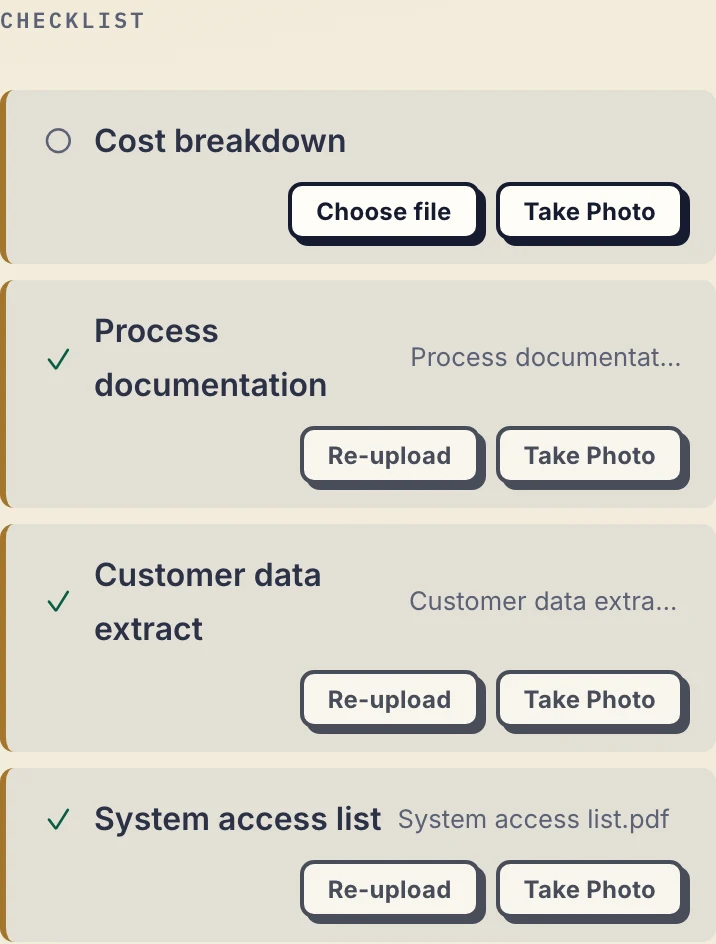
Phone capture with fictional Granger Foods data: the client's view of requested and supplied documents. It does not show a measured pilot result or remaining storage.
When paying is the cheaper option
The paid plans have no plan-imposed retention limit, subject to expiry settings, deletion and cancellation, and they raise the rest:
- Solo, €19/month or €190/year plus tax: unlimited clients, 50 GB, a 1 GB file limit, one seat
- Practice, €49/month or €490/year plus tax: 250 GB, 2 GB files, five seats including the owner
- Studio, €99/month or €990/year plus tax: 1 TB, 5 GB files, unlimited team members
A colleague needs Practice or Studio; Solo does not add seats. Storage add-ons on paid plans cost €15/month or €150/year plus tax each, add 500 GB and raise the file limit to 5 GB. Paying for capacity does not turn Droplana into a records archive, a CRM or a project manager.
Some capability does not depend on the plan at all. On every plan, Free included, you can connect an AI assistant or automation tool through Droplana's MCP server, and send outgoing webhooks when a document is uploaded or a checklist is completed.
More on the decision in why pay €49 a month for a client portal and the simplest client portal for freelancers. The freelancers page is the closest match if a free tier is all you need.
Questions before you start
Is a free client portal a trial?
Often not. Several products offer free tiers rather than time-limited trials. They differ in where the limit sits: number of clients, total storage, maximum file size, how long files are kept, and whether clients can upload at all. Droplana Free is not a trial and does not end after a set period.
Can a colleague help me on the Free plan?
No. Free and Solo each have one seat, taken by the owner. Practice includes five people in total, including the owner, and Studio has unlimited team size. Client allowances are separate from team seats, so adding a colleague never uses up a client.
Do my clients lose access after 180 days?
No. The Free retention rule expires files, not clients, portal access or the Free account. You can keep exchanging new files with the same clients. Download anything you need to keep before it expires.
Want to try it on a real client rather than a demo? Start free with three clients and no card.