
How Long Should You Keep Client Files? A Practical Guide
Keep client files according to a reviewed retention policy. Separate your obligations from Free expiry, paid storage and cancellation, with a planning template.

How long you should keep client files depends on the document, its purpose and the rules that apply to your business. There is no universal period to copy into every client folder. Have the relevant retention and deletion requirements reviewed together; do not automatically choose the longest period or use a software plan limit as your policy.
Droplana is a client portal for sending documents and receiving files back. It groups the exchange by client, but it does not decide how long your business must retain records or act as a long-term archive.
How long should you keep client files? Start with the category
Prepare a list of the documents you hold before asking for a period. A draft proposal, a final deliverable and an identity document may have different purposes and requirements, even when they belong to the same client.
Bring these questions to a qualified adviser for your jurisdiction and work:
- Which retention duties apply to each document category, and when does each period start?
- Are there claims, investigations or preservation requirements that change the planned deletion action?
- What have your contracts promised about returning, retaining or deleting documents, and do those terms conflict with other requirements?
- What personal data remains necessary, and what should be removed sooner?
Under GDPR, personal data should be held no longer than necessary for its purpose. Retention policies help put that principle into practice; it is not a universal number of years. See the European Data Protection Board's retention guidance.
A claims period is not automatic permission to keep every document until it ends. A contract does not settle conflicting obligations by itself. Treat those conflicts as review questions, not as a calculation where the largest number wins.
A retention planning template
Illustrative worksheet for review, not a completed legal policy. Fill in the missing periods only after checking the requirements for your circumstances.
| Record category | Purpose and rule to confirm | Trigger and action | Responsible person |
|---|---|---|---|
| Drafts and working copies | Why is this version still needed? | Review at project close; confirm what may be deleted | Engagement lead |
| Final deliverables and client returns | Which records must be retained, where and for how long? | Record the approved start event and review date | Records owner |
| Identity or other sensitive documents | Is the full copy still necessary? Which specific duties apply? | Confirm retention or deletion before removing it | Designated reviewer |
| File comments and activity records | Is this context needed alongside the document? | Check the export contents before closing the portal | Records owner |
For each row, add the approved period, source of the requirement, storage location and any hold that prevents routine deletion. Record who authorized an exception and when it will be reviewed. Do not label the worksheet approved until that review has happened.
Separate your policy from Droplana's storage rules
| Situation | What happens to files |
|---|---|
| Free | Each file is kept for up to 180 days after upload; earlier expiry or deletion still applies |
| Active paid plan | No plan-imposed retention limit; explicit expiry and deletion still apply |
| Cancelled paid subscription | After the 15-day grace window closes, expiry is capped by 90 days after that close, 365 days from upload, or an already earlier expiry |
| Account deletion | All active account data is removed immediately |
| Disaster-recovery backups | Not user-accessible; their system-defined retention period is not published |
Free's limit expires files, not the client or their portal access. Its other limits are three clients, 2 GB total, 100 MB per file and one owner seat. Active paid plans start at €19/month or €190/year plus tax for Solo. More storage does not determine how long you may or must keep personal data.
You can set an expiry on an individual file at upload. Use a reviewed policy to choose it, and keep required records in suitable storage before portal expiry. Cancellation is a separate event: the grace deadline follows the recorded billing-period end by 15 days, or cancellation time if no period end is available.
Keep the record and the relevant context
When you send a draft and a client returns comments or a replacement, decide what belongs in the final record before deleting the working exchange. A downloaded PDF alone may not explain why a replacement was requested.
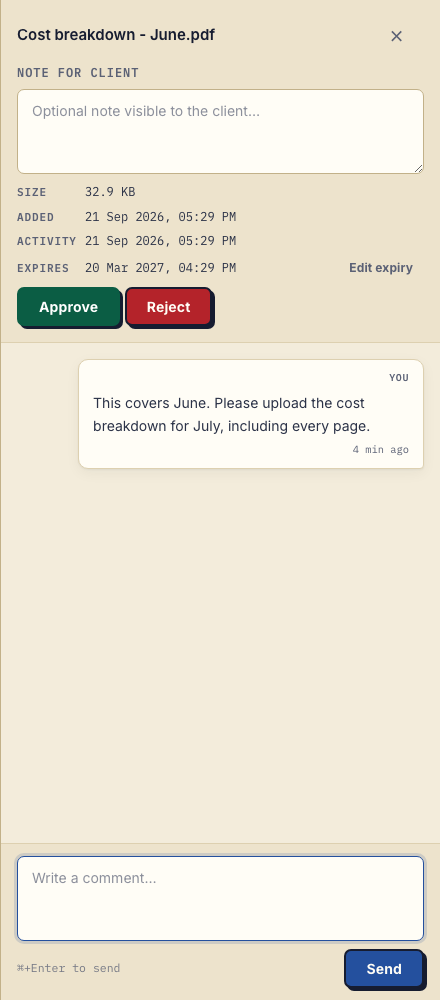
Actual desktop capture with fictional Clearpath Studio and Alex Morgan data. The comment requests a correction to the returned month. It illustrates context to review when closing an exchange, not a retention rule or legal hold feature.
Account data exports as JSON and the owner's activity trail as CSV. File downloads are separate: ZIP supports up to 2 GB or 2,000 files; larger folder downloads require a Chromium browser. Open the exports and check which documents and context they contain before removing anything from the portal. Do not assume one download includes every file and record.
Put the reviewed policy into use
Keep the decision and its execution together. At the review date, check for changed requirements or a hold, carry out the approved action, and record what was retained, returned or deleted. Include copies in other systems in that process. Portal deletion does not remove a copy someone downloaded earlier.
For organizing the exchange, see client document management. The guide to GDPR-compliant file sharing with clients covers the wider data-handling questions, and the accounting practices page applies the workflow to recurring client work.
Compare Droplana's plans if you need a portal for active exchange. Decide separately where required long-term records will live.
Questions before you start
How long should a professional firm keep client files?
There is no universal period. Have the retention duties, deletion requirements, contracts and any preservation needs reviewed for each document category and jurisdiction. A portal storage limit is not a legal retention policy.
Does a paid Droplana plan keep files forever?
Active paid plans have no plan-imposed retention limit. Explicit file expiry, deletion and cancellation rules still apply. Droplana is for active client document exchange, not a long-term records archive.
What happens to files on Free?
Free files are kept for up to 180 days after upload, subject to earlier expiry or deletion. The clients, their portal access and the Free account remain. Download required records before expiry and keep them in suitable storage.
Can I recover deleted records from backups?
Droplana backups are for disaster recovery and are not user-accessible. Their system-defined retention period is not published. Account deletion removes all active account data immediately, so inspect your exports before deleting the account.