
Project Management With a Client Portal
Project management with a client portal: compare three setups, from an all-in-one suite to a separate document portal, and see a client feedback handoff.

Project management with a client portal can mean shared tasks inside one platform or a separate document portal alongside an internal project tool. Choose by what clients must do: manage work with you, or send inputs and review deliverables. Droplana covers the document exchange, not the project-management part.
Three setups for project management with a client portal
Shared project system. If clients must assign work, change task deadlines, inspect dependencies or see a live project timeline, evaluate a project-management product with suitable client access. Demonstrate those actions and check permissions before buying. Droplana does not supply them.
Separate document portal. Keep your existing work tool for tasks and use a portal for documents and feedback. This can suit agencies or consultants whose clients do not need the internal board. The cost is maintaining the handoff between tools. Read the portal without project management guide for that narrower setup.
Document exchange without a project system. If an engagement has a few inputs and a deliverable, a checklist and file feedback may cover the client-facing work. This is not a substitute for staffing, budgets or project schedules if those become necessary.
If Basecamp or Assembly (formerly Copilot) is on your shortlist, the Basecamp comparison and Assembly comparison look at each product separately. Verify your required client actions rather than assuming the word portal means shared project management.
Illustrative handoff: a five-person studio
The studio tracks a homepage project in its internal board. It keeps task owners, estimates and internal notes there. In Droplana, the client receives a request for copy and approved product photos. After reviewing the inputs, the studio shares Homepage Concepts - Round 2.pdf.
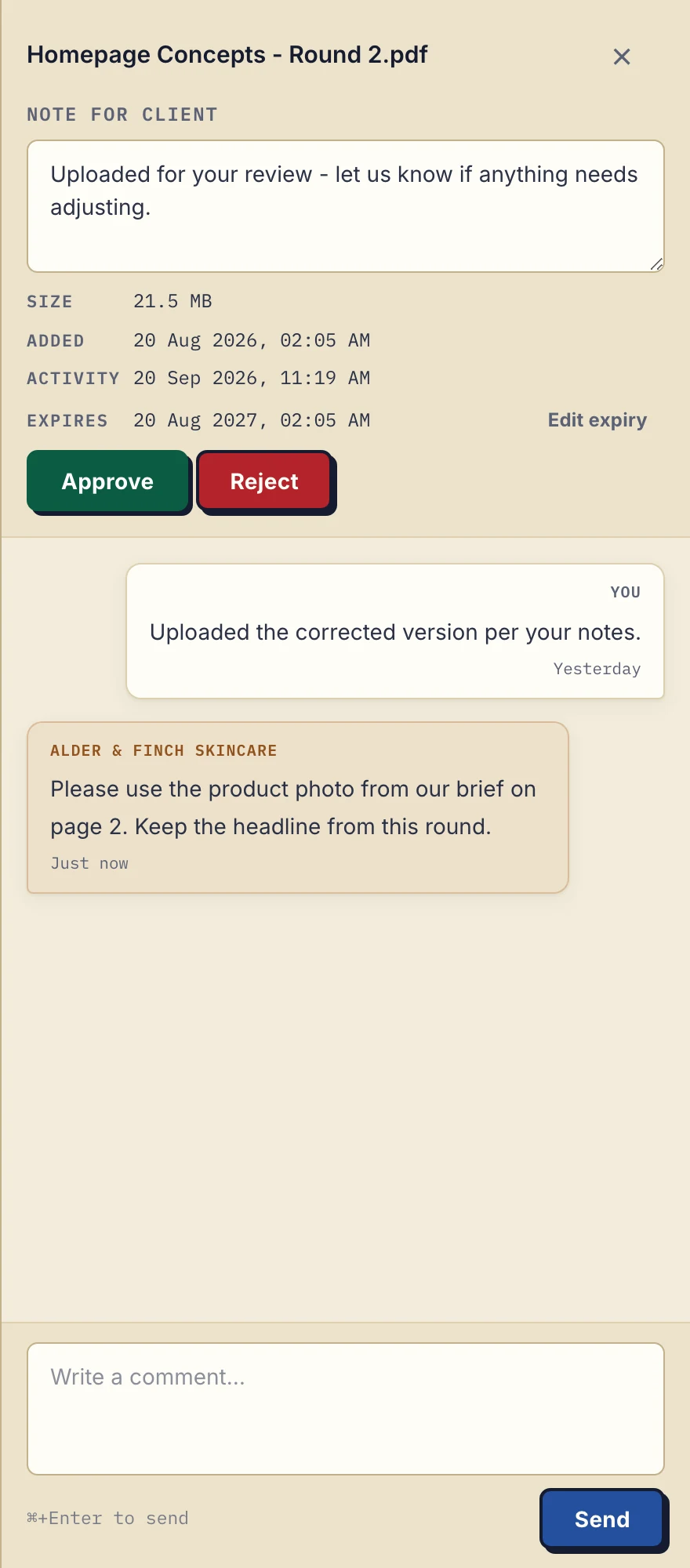
Product demonstration with fictional data: the business-side desktop sidebar for Alder & Finch Skincare. The client asks for a different photo on page 2; the reply stays with that PDF. Open the full-size capture.
The client requests another product photo on page 2. The project lead must read that comment and create or update the design task manually. After the designer finishes, the lead uploads the corrected PDF, asks for feedback on it and updates the board.
Use this handoff check:
- Which exact file received the comment?
- Who will record and perform the work internally?
- Which new file contains the correction?
- Has the client been directed to review that file?
- Has the internal task been updated after review?
No board updates itself. Droplana has no connector to project tools, and a client portal is not an integrated layer over your project system merely because you use both. Two things can shorten the handoff if you want them: an AI assistant connected through the Droplana MCP server can list the comments and missing checklist items for a client, and outgoing webhooks can tell an automation tool that a comment arrived. Both work on metadata, not on the contents of the PDF, and a person still decides what the task is.
What document status means
Either side can set a file to Approved or Rejected, or clear it. That status is not a locked milestone, a task assignment or a dependency. The file-sharing guide explains how to keep the exchange focused on the document.
A checklist tracks requested documents; the business still checks their contents. Checklist items can have optional due dates. A due-date reminder is prepared two days before the date and on the date, is not sent once the item is supplied, and reaches the client with their next email; the business and the client can turn them off. Separately, the fixed inactivity ladder nudges the client after 7 days without activity while items are missing, then escalates to the business after 14 days. Inactivity reminders are on by default and can be disabled. Neither schedule supplies branching, task assignment or dependencies.
Verify access and total cost
Droplana is a client document portal for service businesses. Clients do not create an account. In the default Strict mode, they verify their email on a new device; the verified browser is remembered for 90 days. A persistent portal address does not promise permanent file retention.
Free includes 3 clients, 2 GB total storage, a 100 MB per-file limit and 1 business seat. Files are kept for up to 180 days after upload; the clients, their portal access and the Free account do not expire with those files.
Solo costs €19/month or €190/year plus tax, with unlimited clients, 50 GB total storage, a 1 GB file limit and 1 seat. Paid plans have no plan-imposed file-retention limit, subject to expiry settings and account status.
Practice and Studio add team seats and storage; Studio costs €99/month or €990/year plus tax, with 1 TB, a 5 GB file limit and unlimited seats. The illustrative studio would need Practice for its five business users, as the last question below explains. Count the existing project-tool subscription separately: Droplana does not replace it. See pricing for the full plan comparison and client portal software for document-portal buying criteria.
Keep your current platform if its client view already meets the requirement. Try a separate portal only when the document exchange merits its own location and someone can own the manual handoff.
Questions before you start
Does Droplana provide project management with a client portal?
Droplana provides the client document portal. It has no project boards, task assignees or dependencies; keep a project tool for that work.
How does client feedback reach my project tool?
A person reads the file comment and updates the project tool. Droplana has no connector to project tools, so nothing syncs by itself. If you already use an automation tool, Droplana can send it signed webhooks when a comment is added or a document is uploaded, and you decide what happens next.
Which Droplana plan supports a five-person studio?
Practice includes 5 seats including the owner and costs €49/month or €490/year plus tax. It includes unlimited clients, 250 GB total storage and a 2 GB per-file limit.
Follow the setup instructions for a first-client exchange, then use Free if the workflow and limits fit.